
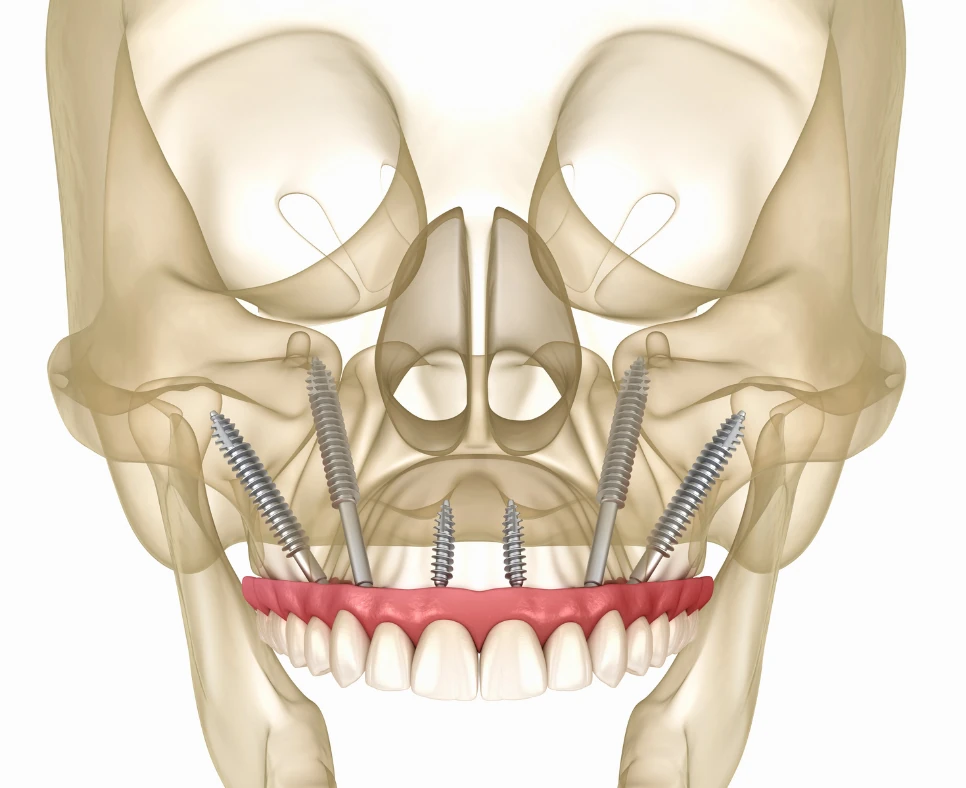
If you have been told your upper jaw does not have enough bone left for standard implants, someone has probably raised zygomatic implants. Two questions usually follow. Is it safe, and is it the only way?
We place zygomatic implants, and they can support a full fixed All-on-4 bridge in a jaw that has lost most of its bone. We also check every case to see whether there is a more conservative route to the same fixed teeth, and often there is. Either way, you leave with teeth.
What A Zygomatic Implant Is
A standard implant anchors into the jawbone. A zygomatic implant is much longer and anchors into the zygomatic bone, which is your cheekbone. It passes above the part of the upper jaw that has lost bone and picks up support somewhere that has not.
The back of the upper jaw is where bone runs out first. Years in a denture, a maxillary sinus that has expanded downward into the space where roots used to sit, long-standing gum disease, or an old injury can all leave too little height to hold a standard implant back there. Zygomatic implants were designed for that situation, and they let a full-mouth restoration such as All-on-4 go in without grafting the back of the jaw first.
They are usually placed in pairs, one on each side, taking the two back positions in an All-on-4 bridge while standard implants take the two at the front. Where there is no usable bone at the front either, four zygomatic implants can be used instead, two per side. One runs from the lateral incisor region up to the cheekbone and one from the first molar region, angling toward each other. That version is planned around a small area of target bone and around the orbit, so it takes careful planning and a lot of experience to do well.
Are Zygomatic Implants Safe?
Yes, in the sense that matters to you: they are a recognized technique with a long clinical record, and survival rates in the published literature sit alongside standard implants placed after grafting.
The honest caveat is that the outcome depends more on planning than it does with a routine implant. The implant travels a long way through a region that includes the sinus and sits near the orbit, so where it enters and the angle it takes have to be worked out before surgery rather than judged during it. Practices that place them well plan them on a CBCT scan and place them with navigation. We do both, on every All-on-4 case we do, zygomatic or not.
The complications that get discussed are mostly sinus-related. Some patients develop sinus inflammation after zygomatic placement, which is why sinus health is assessed as part of the workup and why the entry point is planned around the sinus wall rather than straight through it wherever the anatomy allows. Soft tissue around the implant head needs proper maintenance because it sits higher and further back than a normal implant, which makes cleaning less intuitive. None of that makes the technique unsafe. It makes it a technique that rewards planning and follow-up.
Do You Actually Need Them?
This is the part worth slowing down on, because being told you need zygomatic implants is not the same as needing them.
Most practices that raise zygomatic implants are looking at a scan and seeing one route to a fixed result. Depending on what else your anatomy has to offer, there can be others.
Once or twice a year we see a patient who came to us specifically because they had been told they needed zygomatic implants and their own dentist did not place them. In several of those cases we were able to reach the same fixed All-on-4 result with a sinus graft and pterygoid implants instead, and the cheekbone was never involved. One of those patients came back for a recall a few years later. The implants were holding, the bite was stable, and the smile looked more natural than what she started with.
What We Look At Before The Cheekbone
None of the following is about avoiding zygomatic implants. It is about using your own bone where your own bone will do the job, because that usually means simpler surgery and something easier to maintain and adjust years down the line. All of these routes end in the same place: one fixed bridge, fitted the same day.
Pterygoid implants. These anchor into dense bone behind the sinus, at the very back of the upper jaw. For a lot of patients told they need zygomas, this is the option nobody mentioned. It reaches the same part of the arch from a different direction. More on pterygoid implants.
Tilted posterior implants. This is standard All-on-4. Angling the back implants forward lets them find available bone and support a longer bridge without leaving the jaw.
Six implants instead of four. Where there is bone to place them, All-on-6 spreads load differently and changes what the back of the arch has to carry.
Sinus grafting. Rebuilding bone under the sinus reopens the posterior maxilla to standard implants. It adds months of healing, and for plenty of patients that trade is worth making.
Zygomatic implants. When the bone genuinely is not there, this is the answer, and we place them.
Which of those applies to you comes down to a scan. That is the whole reason a second opinion is worth having before you commit to anything.

Zygomatic Implants And All-On-4
All-on-4 rests a full fixed bridge on four implants, two straight at the front and two tilted at the back. It works when there is enough bone at the front of the upper jaw to take the anterior implants and enough at the back to take the tilted ones.
Where the back of the jaw cannot support a tilted implant, the two posterior positions can be zygomatic instead. You still get one fixed bridge on four implants, fitted the same way. Where the front has bone loss as well, all four positions become zygomatic.
So a severely resorbed upper jaw does not rule out a same-day fixed bridge. It changes where the support comes from.
What Treatment Looks Like
The sequence is the same whichever route your case takes.
Planning comes first: a CBCT scan, a review of the sinuses and the available bone, and a digital plan built in Simplant. Surgery is carried out with Navident navigation, so each implant goes where it was planned to go rather than where it looks right on the day. This is the same protocol behind every All-on-4 case we do.
Implants are placed and a fixed long-term provisional bridge goes on, so you are not without teeth at any point. That bridge stays while everything integrates. Your final restoration is made in our in-house lab and fitted after healing, usually a few months later depending on the case.
With proper care, implants can last a lifetime. We still see patients from our earliest full-mouth cases for follow-up.
What Zygomatic Implants Cost
We do not publish a single number for this, because a zygomatic case is priced on what it involves. The things that move it are how many zygomatic implants the plan needs, whether any grafting is still required elsewhere in the arch, the material of the final bridge, and what sedation the case calls for.
What we can tell you is that the comparison worth making is not a zygomatic All-on-4 against a standard All-on-4. It is a zygomatic case against grafting the jaw and then placing standard implants, which is two surgeries and a long wait in between. Once you price both routes end to end, they are closer than they look.
Dental insurance rarely covers full-mouth implant treatment in any form, though some plans contribute toward extractions or the prosthesis. We go through what your plan does and does not cover at the consultation.
Bring Us The Scan
If another practice has told you zygomatic implants are your only option, or that you are not a candidate for All-on-4 at all, come in with the scan and let us look at it properly.
We take a CBCT scan and x-rays at your consultation at no charge, review what you have already been told, and give you the alternatives if your anatomy has any. If zygomatic implants really are the right answer, we will tell you that, and we place them.
Call (833) 454-4579 to book a consultation in Manhattan, Long Island, Westchester or New Jersey, or request a consultation online. You can also see before and after cases from full-mouth patients.
Common Questions
Are zygomatic implants safe?
They have a long clinical record and survival rates comparable to standard implants placed after grafting. The technique depends heavily on planning, which is why the CBCT scan and the navigation matter.
What are the complications of zygomatic implants?
Sinus inflammation is the one most reported. Soft tissue around the implant head needs more attention than a standard implant because of where it sits. Both are managed with proper planning and regular follow-up.
Can zygomatic implants fail?
Any implant can. Zygomatic implants have the advantage of anchoring in dense cheekbone rather than resorbed jawbone, which is why they were developed for these cases in the first place.
What is the alternative to zygomatic implants?
Pterygoid implants, standard tilted All-on-4, All-on-6, or sinus grafting followed by standard implants. Which of these is open to you depends on your scan.
Are zygomatic implants better than bone grafting?
They are faster, because grafting means a second surgery and months of healing before implants go in. Grafting rebuilds your own bone, which some patients prefer. Neither is universally better.
Can I get All-on-4 with zygomatic implants?
Yes. The two back positions, or all four, can be zygomatic where the jaw cannot support standard or tilted implants. You still get one fixed bridge.
How long does recovery take?
Expect more swelling in the first week than with a routine implant placement. You leave with a fixed provisional bridge on the day of surgery and eat soft foods while everything settles.