

All-on-4 dental implants replace a full arch of teeth on four implants, and the whole approach depends on placing those four implants in exactly the right positions. There is no spare bone to work with and no second attempt. Computer-guided surgery is how that accuracy is achieved: the implant positions are decided in software before the day of surgery, and technology holds the surgeon to that plan while the implants are placed.
Our periodontists use both methods of guided implant surgery, static surgical guides and dynamic navigation, and choose between them case by case.
What Is Computer-Guided Implant Surgery?
Computer-guided surgery is a digital workflow combining 3D imaging, implant planning software and guided placement technology to position dental implants according to a plan made in advance.
Rather than relying on visual judgement alone, as in freehand placement, the surgeon controls the angle, the depth, the position and the relationship between implants digitally before any incision is made. That level of precise implant control matters more for the All-on-4 procedure than for almost any other implant treatment, because the posterior implants are deliberately tilted and the whole arch is immediately loaded with a fixed dental bridge on the day of surgery.
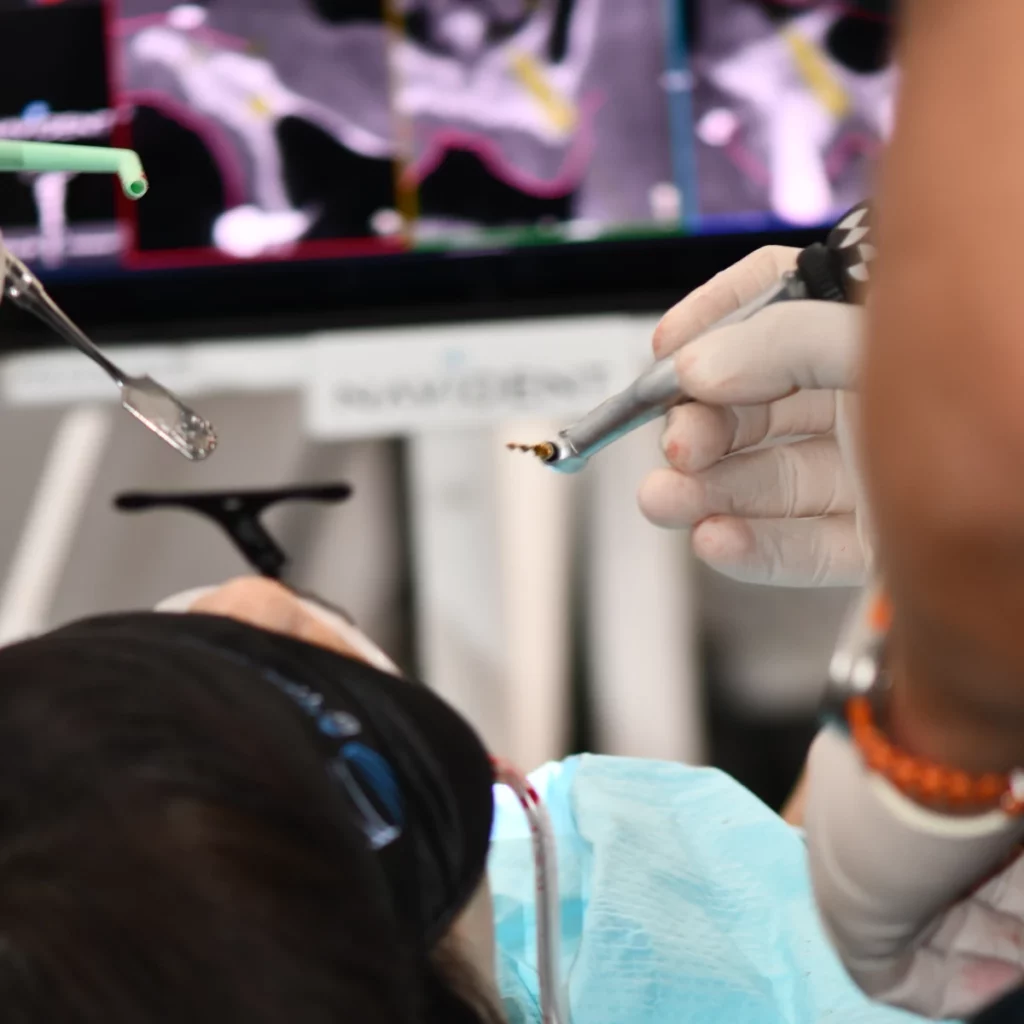
Why Computer-Guided Surgery Matters For All-on-4
A single implant crown has tolerance. A full-arch prosthesis has very little. Four implants have to support twelve teeth, and every one of them has to sit where the final prosthesis needs it.
Three things make guided implant surgery close to essential in All-on-4 treatment:
- Tilted posterior implants. Angling the back implants is what allows the dental bridge to reach the molars and what removes the need for bone grafting in most cases. Those angles are calculated, not estimated.
- Anatomy that cannot be crossed. The maxillary sinus above and the inferior alveolar nerve below define the working space. Guided placement keeps the implants clear of both.
- Immediate loading. Because a provisional bridge goes on the same day, the implant positions have to match what the dental laboratory has already prepared.
Where bone density is poor or bone volume is limited, guided surgery is often what makes graftless dental rehabilitation possible at all, by finding and using the bone that remains rather than adding more. Much of the reported success of All-on-4 treatment rests on this planning stage rather than on the surgery itself.
The Digital Workflow Behind Computer-Guided All-on-4 Surgery
The planning happens before surgery, not during it. Step by step:
- CBCT imaging. A cone-beam scan produces a three-dimensional model of both jaws, showing bone density, bone volume, the sinus floor and the nerve canals. This 3D imaging is the foundation of every decision that follows.
- Intraoral scanning. A digital scan of the mouth records the soft tissue and any remaining teeth, and is merged with the CBCT data.
- Digital treatment plan. Using implant planning software, the periodontist positions all four implants virtually, sets the angle of the posterior implants, and designs the prosthesis at the same time. The treatment plan works backwards from where the new teeth need to sit.
- Guided placement. The plan is transferred to the operating room by one of two methods, described below.
- Immediate prosthesis. Multi-unit abutments are fitted and a fixed provisional bridge is attached the same day, with the final prosthesis produced once the implants integrate with your jawbone.
Static Surgical Guides And Dynamic Navigation: The Two Methods
Both transfer the same digital treatment plan into the mouth. They do it very differently.
Static Surgical Guides
A surgical guide is a physical template, manufactured in advance from the plan, that seats over the jaw and constrains each drill to the planned angle and depth. In full-arch cases a second surgical guide is sometimes used for bone reduction before the implants are placed.
Static guides are highly predictable when the plan is settled and the anatomy is well understood. Their limitations are that the surgical guide has to be fabricated before surgery, cannot be altered once made, occupies vertical space in the mouth, and can obscure the surgical field.
Dynamic Navigation With Navident
Dynamic navigation replaces the physical surgical guide with real-time tracking. We use Navident, made by ClaroNav.
A small marker is fixed to the jaw and another to the handpiece. After a calibration step registers the patient’s anatomy against the CBCT data, optical cameras follow both markers, and the screen shows the drill’s angle, depth and deviation from the plan in millimetres as the osteotomy is prepared. The comparison people find useful is satellite navigation: the route is planned in advance, but your position against it stays visible throughout the procedure.
Because nothing physical sits in the mouth, dynamic navigation works where a guide struggles. It suits limited mouth opening and posterior implants, it keeps the surgical field visible, and above all it can be adjusted during surgery. In the All-on-4 technique that matters, because remaining teeth are usually extracted on the day of surgery and the bone found underneath is not always the bone the scan suggested.
| Static Surgical Guide | Dynamic Navigation | |
|---|---|---|
| How the plan transfers | Physical template constrains the drill | On-screen tracking shows drill position live |
| Made in advance | Yes, surgical guide must be fabricated | No physical guide required |
| Adjustable during surgery | No | Yes |
| Vertical clearance needed | Yes | No |
| Surgical field visibility | Partly obscured | Fully visible |
| Same-visit scan, plan and place | Fabrication adds time | Possible in one visit |
Many All-on-4 implant centers use one or the other. We use guided implant surgery in both forms, and the choice is part of the treatment plan rather than a fixed protocol.
Benefits Of Computer-Guided All-on-4 Surgery
- Accuracy. Optimal implant position in three dimensions, with the angle of the posterior implants calculated rather than judged.
- Safety. The sinus and the nerve are mapped before surgery and avoided during it.
- Minimally invasive placement. Guided workflows often allow a flapless approach, with less swelling and a more comfortable recovery.
- Shorter time in the chair. The decisions are made in software rather than at the chairside.
- Better prosthetics. When implants land where the plan intended, the final prosthesis fits as designed and the load is distributed as intended, which is directly related to long-term implant survival rates.
- Reduced need for bone grafting. Precision allows existing bone to be used more fully, which is central to graftless full-arch treatment.
Who Is A Candidate For All-on-4 Dental Implants?
Most people missing a full arch of teeth, or facing the loss of the teeth that remain, are candidates. Four implants per arch is the standard configuration, though some cases are better served by five or six implants.
What the planning stage is really assessing is whether there is enough bone in the right places to place implants without grafting. Guided workflows widen that group considerably. Patients told elsewhere that they need extensive grafting, or that they have too little bone for implants at all, are frequently treatable once the anatomy is mapped properly in three dimensions.
Medical history matters too. Uncontrolled diabetes, smoking and osteoporosis all affect healing and are discussed openly before treatment is planned.
Computer-Guided Surgery Versus Freehand All-on-4 Placement
Freehand placement relies on the surgeon’s experience, the scan reviewed beforehand and direct vision during surgery. In skilled hands it works, and traditional implant dentistry was built on it. Many dentists still place implants this way.
The difference is consistency. Published research comparing guided dental implant surgery with freehand placement finds smaller deviations between planned and achieved implant positions when either static or dynamic guidance is used. For a single tooth, a small deviation is usually absorbed by the restoration. Across four implants carrying a full arch, deviations compound, and a compromised implant position raises the risk of implant failure or a prosthesis that never fits comfortably.
Is Computer-Guided Surgery Required For All-on-4?
Technically no. Clinically it is strongly recommended, and it is standard in every serious full-arch practice.
The reason is immediate loading. When teeth go on the same day, there is no window in which to discover that an implant sits differently from the plan. Guided surgery removes most of that risk before the patient sits down.
Why Technology Matters When Choosing An All-on-4 Implant Center
Guided surgery is one part of a digital dental workflow, and it works best when the rest of it is in place. Our dental technology includes CBCT 3D imaging, Trios intraoral scanning, Simplant and Navident planning software, photogrammetry for recording implant positions accurately across a full arch, Lucid drills that shape the osteotomy without overheating bone, multi-unit abutments, and an in-house dental laboratory producing dental restorations by 3D printing and Procera milling.
The in-house dental lab matters more than it sounds. The plan made in software and the bridge fitted to your mouth are produced by the same experienced dental team in the same building, so nothing is lost between the two.
When comparing All-on-4 dental implant centers, it is fair to ask which planning software is used, whether the dental professionals involved use guided implant surgery or place implants freehand, whether titanium implants from an established manufacturer are used, and whether the laboratory is on site. Not every dentist offering full-arch treatment places implants under guidance.
Caring For All-on-4 Implants Long Term
A fixed full-arch bridge is cleaned rather than removed. Daily brushing, cleaning underneath the bridge with the tools your dental team recommends, and regular dental visits are what protect the investment.
Those visits are not cosmetic. The gum and bone around implants can become inflamed in the same way they do around natural teeth, and catching that early is the single most useful thing routine dental care does for implant patients. Good oral health around the implants determines the long-term health of the implants themselves, and implants provide decades of function when that maintenance is kept up.
Frequently Asked Questions
Will Guided Or Navigated Placement Be Used For My Surgery?
One or the other, in almost every case. Which one is decided during treatment planning and depends on the anatomy, the extractions needed and how much is likely to change on the day of surgery.
Do You Use CBCT Scans For Planning?
Yes. A CBCT scan is taken for every full-arch case. Planning an All-on-4 treatment without one is not possible.
Does Guided Surgery Reduce Pain Or Recovery Time?
It often helps. Guided and navigated placement frequently allow a flapless or minimally invasive approach, which generally means less swelling and a faster return to normal activity than a fully reflected flap.
Can All-on-4 Implants Still Be Placed In One Day With Guided Surgery?
Yes. Scanning and planning happen beforehand, so the surgical visit is not lengthened. With dynamic navigation there is no guide to manufacture, which can shorten the overall timeline further.
How Long Do All-on-4 Dental Implants Last?
The implants themselves can last a lifetime with proper care. Long-term studies of implant-supported full-arch fixed prostheses report survival of around 93% at ten years and 87% at twenty, and a systematic review of immediately loaded implants across thirty-four studies found mean survival of 97.4%.
The bridge is the part more likely to need attention over time. Chipping, wear and the occasional repair are normal maintenance on any fixed prosthesis rather than signs of failure, and a bridge can be remade without disturbing the implants underneath it. Longevity depends far more on implant position, bite forces and how well the implants are cleaned than on the implants themselves.
Does Guided Surgery Work If I Have Very Little Bone?
That is often where it helps most. Limited bone volume leaves less margin for error, so planning the implant positions precisely and placing titanium implants exactly as planned is what allows treatment to go ahead without bone grafting in many cases.
Should I Ask My Own Dentist About This?
You can, and many dentists refer full-arch cases to a periodontist for exactly this reason. Full-arch implant dentistry is a specialist procedure, and the planning and placement of implants is what most general dental offices refer out.
Book A Consultation
If you are considering a new smile with All-on-4 dental implants, or you want a second opinion on a full-arch plan you have already been given, a consultation with a periodontist is the place to start. Call (833) 454-4579 or find out if you are a candidate.